When BAD OKRs happen to good people

The days grow short, the season’s end draws near, and, naturally, our thoughts turn to OKRs.
Three little letters, and yet they’re the source of so much consternation - when they go wrong, they can go very wrong. But there’s nothing inherently wrong with OKRs, and they can be a powerful force for alignment. So why do so many of us have bad experiences with them?
There’s a thousand ways that OKRs can be misused, but they generally go wrong at one of three levels:
The individual Squad/Product Development team
Product Management leadership
Senior Management
Most of the time, problems come from the OKRs being either:
Too Big
Focused on a specific Activity, emphasizing effort rather than results and impact
Or they’re Disconnected from overall strategy
And yes, the most common OKR failures spell out BAD: Big, Activity-focused, and Disconnected. This is no accident—it's a really useful way to diagnose and fix the underlying issues.
Let’s focus on these, one team level at a time:
The individual Squad/Product Development team
Too Big
This happens when there’s more than the team can handle on its own. It’s fair for an Objective to span multiple related teams, but each Key Result needs to be achievable by a single team.
And all of the teams working on realising a single Objective need to be working together, in close alignment.
This can pose a real challenge - but approaches like dynamic virtual teams or Kalis (when someone is temporarily seconded to a different team, to address a dependency) can be very effective.
Focused on a specific Activity, emphasizing effort rather than results and impact
That leads to a related issue - when the teams are not aligned, their focus might be on tasks that do not add up to a whole.
This happens often - it’s not for a lack of good intentions, but initial planning and assumptions don’t always hold up when work is engaged. Teams can’t get too precious about HOW they’re trying to achieve a goal.
Disconnected from overall strategy
Sometimes teams have the scope and the means to achieve an Objective - but it’s something that, for whatever reason, is no longer tied to the larger strategy. I’ve seen teams do great work that, when released, achieves nothing.
Teams do what they CAN, not what they SHOULD - they focus on delivering or achieving something (often a vanity metric) that doesn’t advance the overall strategy of the organisation.
This is easily avoided by strong communication and mapping practices. I say ‘easily’, but the reality of many organisations is that this takes deliberate practice - and sometimes some external support - to put into place.
Product Management leadership
Too Big
This usually happens when too much optimism creeps into the OKRs - there’s a lack of realism about the capabilities of the teams, or what’s realistically achievable in the time period.
This happens to almost every team when they first start to use OKRs - it takes some experience and maturity to balance what’s possible with the expectations set by other Executives. Learning how to work with the organisation to do this well is a key development skill for Product leaders.
Focused on a specific Activity, emphasizing effort rather than results and impact
It’s a common complaint among Product people that no one understands what they do. I used to joke that I spent my day going to meetings, so that other people could get work done.
So it’s no surprise that a common issue is getting lost in the weeds, and not being able to step back and focus on the bigger picture. We lose track of the dynamics of the system as a whole - forgetting that, as leaders, that this is one of the most important things we can do.
It’s a delicate balance: you’re being chased for results, and outputs like pushing something to production are seen as a leading indicator of that. Learning how to ensure that the teams you work with are able to ship and demonstrate real value at regular increments, all the while progressing towards the larger initiatives - that’s a real skill. It’s easy to understand why we too often fall into the trap of focusing on an activity instead.
Disconnected from overall strategy
You’ve probably heard of Conway’s Law - essentially, that organisations produce products that are copies of (or shaped by) the organisation’s design.
I like to think that a Product team’s main function is to act against that - to ensure that people and teams work together, across silos, to deliver value to customers in a way that benefits the company.
To do that, Product leaders need to optimise their organisation design to balance the politics of the organisation and deliver the optimal business strategy. When I see too many teams working on Disconnected Objectives or Key Results, it’s a sure sign that this is the problem.
And we wonder why so many people burn out…
Senior Management
Too Big
There are two very common fallacies for Senior Management in this area:
Unrealistic Objectives - things that are not possible to achieve in the time frame, given the capacity, capability, and resources available. This can be addressed with an alignment exercise during the planning cycle - not just briefing out the intentions, but a back-briefing that indicates what teams understand their mission to be, and how they plan to achieve it.
Setting unclear Objectives - when teams can walk away from a meeting without a clear understanding of a hypothesis of how to proceed, they often end up working in silos to do things that don’t add up to a cohesive whole. (This is a fundamental strategy and communication problem, something I cover more deeply in a talk.) At the Product team and Squad level, this often leads to teams working on Disconnected initiatives.
Focused on a specific Activity, emphasizing effort rather than results and impact
A defining feature of this situation is when new strategic initiatives are run via PMO and Gantt charts.
There are strategic initiatives that can be run this way - but they need to be things that have been done before, with a set process and a deterministic outcome. Think of infrastructure projects (though even these often run into issues that need flexibility and agile solutions).
Getting too involved in the details of HOW teams deliver against a goal, when you’re developing new approaches or products, is a sign that the organisation’s culture is brittle, and unlikely to deal well with surprises in market conditions.
Disconnected from overall strategy
One of the most frustrating things for Senior Management teams, especially at larger firms, is just how long it takes for things to come to fruition. Once the Objectives have been determined, there’s nothing active to be done on them for weeks or months, save for governance. The dirty secret of many Executives is that they advanced to their position by executing, often by taking on a hands-on role within the team - and they’re bored when they can’t contribute in this way anymore.
That can lead to various Side projects or Special projects. These show up in chats or meetings, usually starting with ‘Can’t we just… ?’
This leads to two problems:
1. These are often point solutions, disconnected from the overall strategy. At best, they lead to vanity wins.
2. And they steal time, energy, and focus from the agreed strategy, delaying their realisation even further.
That’s not to say that an agreed strategy is sacrosanct or immutable. There are excellent reasons to pivot and refocus - but organisations who don’t do this in a considered manner end up making bigger messes than they solve.
So: what can I do about this?
When I was growing up, GI Joe public service announcements used to say, ‘Knowing is half the battle.’
So (with apologies to Yogi Berra), “Knowing is half the battle. Doing something about it is the other 90%.”
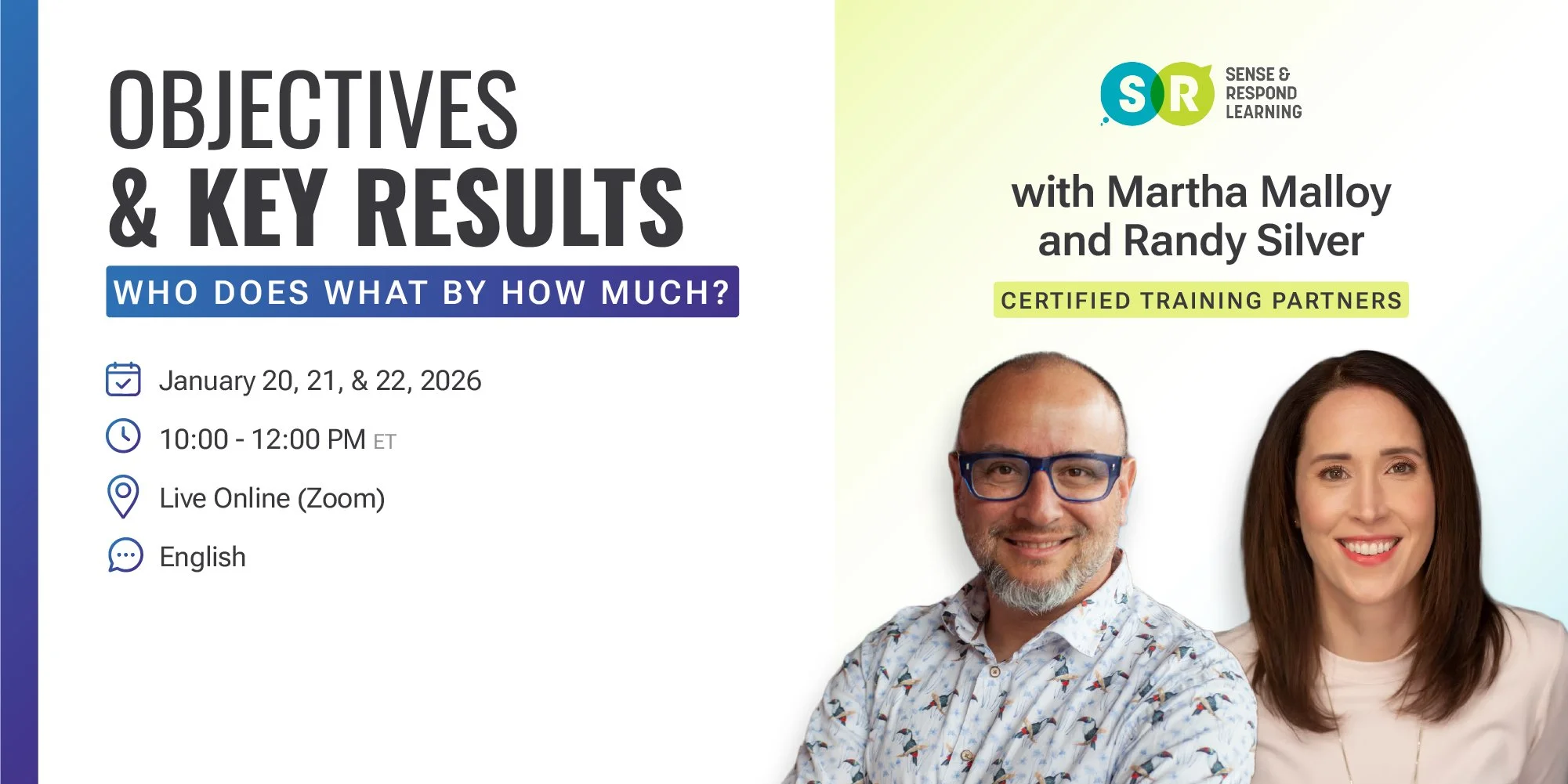
I’m running a Sense & Respond OKRs course in January with Martha Malloy - sign up at go.outofowls.com/OKR