AI Just Broke Your Strategy. Now What?

The way that companies work is fundamentally changing.
Classic Product Management is based on a very simple idea: Waterfall is bad, because we don’t find out if something has value for a long period of time. Agile is good because it allows us to experiment and learn quickly, because building things is time-consuming and expensive.
AI-based tools have fundamentally changed this. We can now build things quickly, and we can do it relatively cheaply. The idea that your CEO brought up this morning? You can have a prototype ready by the end of the week. And if you don’t the CEO might have done it themself.
So if making things - janky as they might be - is no longer the constraint, what needs to change in our approach? How can we learn quickly, with minimal cost and risk, and help our organisations realise value at pace?
Monika Turska once told me that the actual job of Product people is to ‘help people make better decisions, faster.’ That’s still the key. How we do it most effectively is changing.
Our management style has not caught up with this. It’s exposing something that we’ve been able to hide for a long, long time: most of our companies are terrible at Strategy.
It doesn’t have to be this way. There are a few very basic mistakes that I see again and again, and which are addressable. They’re not easy to fix - I won’t lie to you about this - but it’s not hard to diagnose where things are going wrong, and to get to work on fixing them.
Problem #1: You don’t actually have a strategy
I know what you’re thinking: this can’t be true. But you’d be surprised.
Every company says that it has a strategy. They work on it for months, sometimes with ruinously expensive consultants, and then have lavish offsites to come to agreement. That’s followed by fancy presentations. Sometimes they even make sense.
What they always have is an ambition. Sometimes this is a corporate vision, something long-term that sounds good as a slogan and can help guide the general shape of the journey. Google wants to organise the world’s information. Airbnb seeks to create a world where anyone can belong anywhere.
Sometimes it’s a mission. Spotify’s is “to unlock the potential of human creativity—by giving a million creative artists the opportunity to live off their art and billions of fans the opportunity to enjoy and be inspired by it.”
These are great. But they’re not a strategy. They’re a guide.
Most of the time, I see companies come back with something more tangible: We’re going to hit US$50 million in ARR. We’re going to be the number 1 supermarket chain in the UK. We’re going to launch a new feature or product line.
These are also not strategies, and they’re more dangerous - because they sound like they could serve the purpose. But organisations that take this approach end up with a black hole where something solid is needed. The issue that comes up is that no one can make a definitive decision based on these slogans - there’s no tradeoff. There’s no definitive guidance about HOW to achieve the goal, about what you’re going to say NO to along the way. And as a result, people and teams are free to pursue their own ways of getting there, and the lack of alignment ends up killing any chances of achieving the goal.
A good strategy has a few very basic components.
It has a clear-eyed, honest assessment of the market.
It has an ambitious goal – something that is specific, measurable, (potentially) achievable, relevant and timely,
It has an easy-to-understand storyline that tells how we plan to pursue it: what we’re going to try, and what we’re very specifically saying NO - or NOT AT THIS TIME - to.
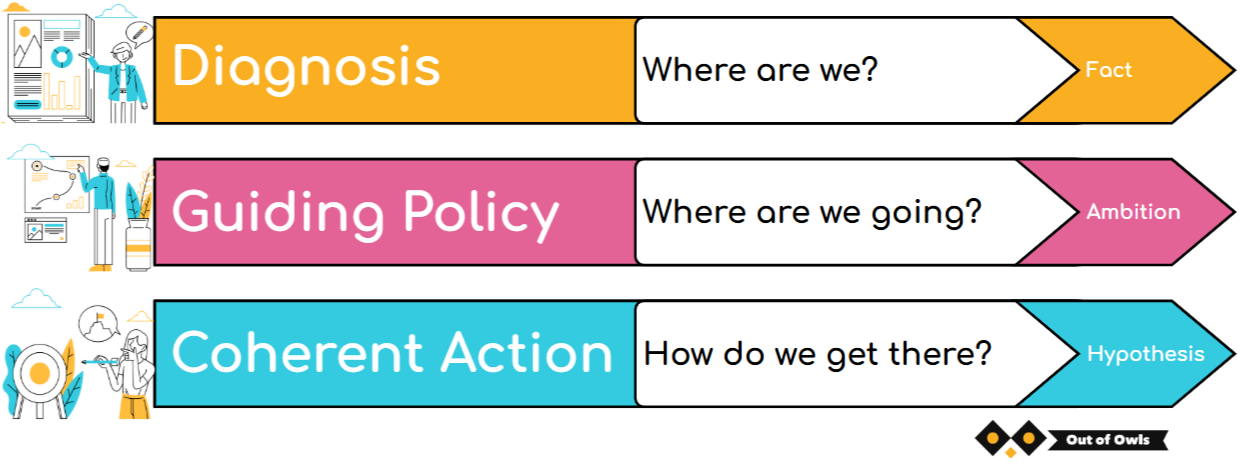
Richard Rumelt (Good Strategy, Bad Strategy) calls this a Diagnosis, a Guiding Policy, and a Coherent Action. Assaph Mehr likes to rephrase them as 3 specific questions: Where are we? Where are we going? And how do we get there?
The idea of sitting down and writing a strategy is scary to a lot of us. It shouldn’t be. If you’ve ever written a user story, you’ve already done it - those 3 questions are also easily recast as a Fact, an Ambition, and a Hypothesis.
(Martin Eriksson also has an expanded, 5-question version of this in The Decision Stack.)
If you don’t have all 3 of these elements present, there’s no way for people to work together - to make effective decisions, to prioritise across teams, and to do the work that’s needed for success.
PROBLEM #2 - We have lots of Strategies
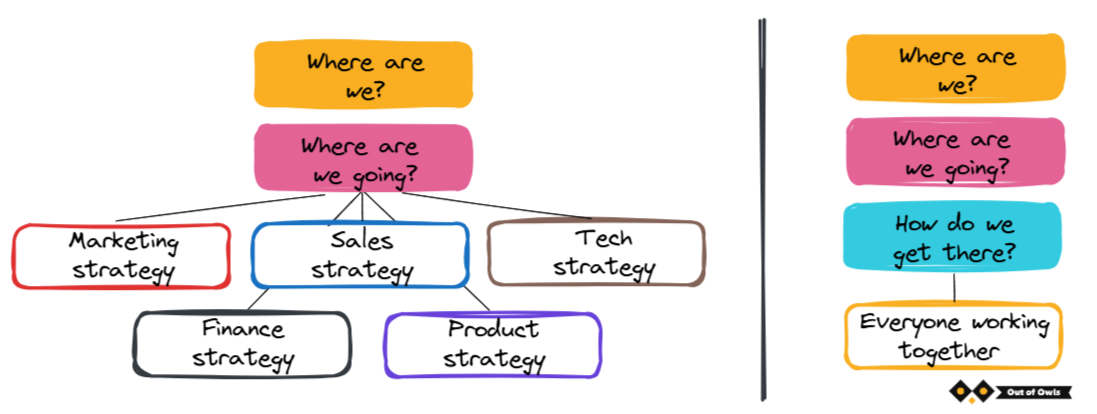
If an organisation misses the third question, they stop working together in any coherent manner. Each department will come up with their own strategy at a local level, and - surprise! - they often don’t add up to anything. Each team optimises to maximise a KPI for something that they can control, and Conway’s Law takes over.
Even companies that deliberately pit different ideas and teams against one another need to do so in a way that has some intention about it.
Matt LeMay has a simple rule for ensuring that your organisation doesn’t have this problem: make sure that team-level goals (OKRs or similar) are no more than one step away from the company-level goal.
This is ultimately an issue with structure & alignment - it’s something that can be addressed by how we govern our goal setting. It’s difficult to address, because an organisation that is prone to letting this happen is also one that’s not set up to recognise the problem and remediate the situation. It takes a real shift in thinking at the executive level.
PROBLEM #3 - That was Last Week’s Strategy!
Another issue that comes up a lot is that organisations make strategic decisions in a reactive fashion: when something happens in the market, they try to pivot and come up with a solution. It’s easy to understand why - we all want to be the hero, and we all want to be in control.
But what happens in practice is that we make those changes only at a local level, and don’t think through what it means more globally. As a result, our Work in Progress bloats and things that are no longer relevant are still being worked on. Sometimes we get attached to them (the Sunk-Cost Fallacy) and can’t let go. Sometimes we fall victim to poor delivery management practices, where progress is measured by shipping specific things instead of focusing on value (Outputs vs Outcomes).
That’s not the biggest issue, though - when things change all the time, we’re suffering from a collective attention deficit. It means that we didn’t think things through well enough at the initial stage, and we don’t have the courage of our convictions. And it means that morale and effectiveness are both significantly challenged.
That doesn’t mean that your Strategy can’t change - pivots happen - but that any change in direction is done so with real intention, and doesn’t happen every time the wind changes direction. When this happens, it’s a failure of executive discipline.
PROBLEM #4 - Communication
You’re likely bored of hearing about the importance of repetition. (I’m certainly bored of talking about it!)
It’s important for a reason: you can have the best Strategy in the world, but it can’t be effective if the people tasked with making it happen have no idea what they’re trying to accomplish.
I see this happening all of the time. The Exec team comes back from the offsite with a bold plan. The board has endorsed it. There’s even a big presentation about it.
And six months later, nothing’s been accomplished. The Execs can’t believe how poorly their teams have performed.
Communication isn’t about what you say, or what you intend. It’s about what other people hear, what they comprehend. The Output is what comes out of your mouth, but an effective Outcome is what they do about it. And the way that we message across our organisations is very lossy.
Say it. Say it again. Ask what people heard, and what they plan to do about it. Use the Briefing and Back-briefing approach.
PROBLEM #5 - The difference between what we SAY and what we DO
Communication isn’t enough, though. Ultimately, strategy isn’t about what your organisation says that it intends to do - it’s about what it actually does.
There’s often a huge discrepancy between what’s in our strategy messaging, what work ultimately gets funded, and what people are actually spending their time on. Our strategy is about the shiny, new, game-changing things - but much of our days are spent on the stuff that’s not very sexy: compliance, regulatory, & security work; big fixes and incidents; keeping the lights on and maintenance work. Not to mention process-based corporate bureaucracy, reports, meetings, etc.
I like to use an adaptation of Teresa Torres’ Opportunity Solution Tree (OST) to map this out. Start with the ideal OST, based on the Strategy as communicated - but then add on all of the work that’s been funded, and what people are spending their time on. There’s always a huge lump of stuff that can’t be stopped, but which wasn’t mentioned in any of the Strategy documents.
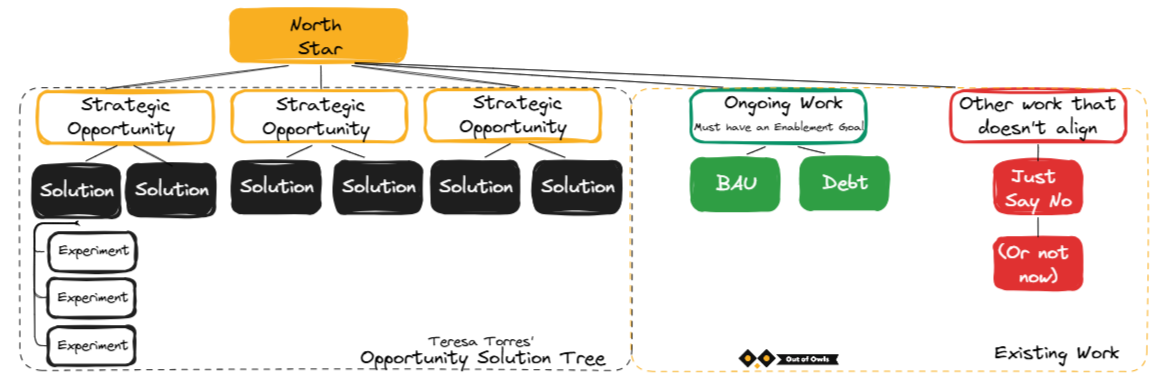
Call this out. Make it clear that there’s work being done in service of the New/Change Strategy, but also what work is being done that’s in support of ongoing BAU or Enablement.
Once this is brought out into the open, it’s the management team’s job to make one of two decisions:
Cut back on some of the ongoing work that’s being done. Kill it, deprioritise it, or automate it.
Or scale back on some of the ambition, once it’s clear that there’s not the capacity for it.
There are other options, of course - you can bring in more people, but that takes time. You can outsource it, but that’s expensive and comes with a whole host of other challenges. You can even fool yourself about it. I once had a CEO tell me that the problem with us (the company his team had acquired) was that our subsidiary ‘were an OR company. You do this OR that. We are an AND company.’ I don’t think I need to tell you about how that went for them.
So:
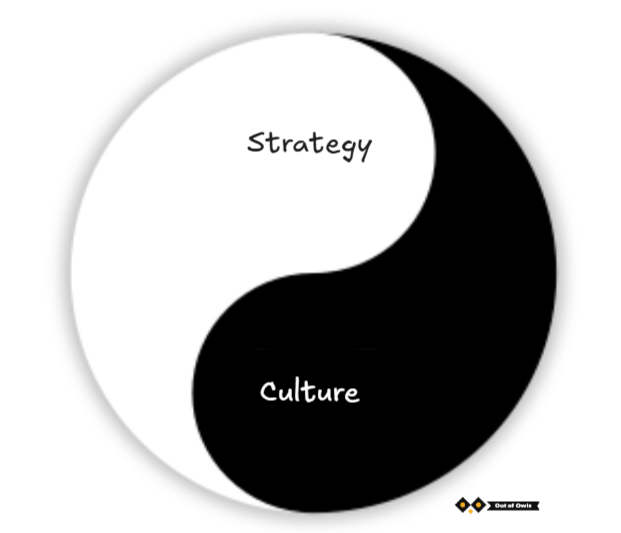
Culture may eat Strategy for breakfast - but that doesn’t actually mean that you can get by for long without a strategy in place. Your organisation’s strategy is the anchor that your culture - how you work together - is built on top of. Neither will add any value without the other working to enable it.